
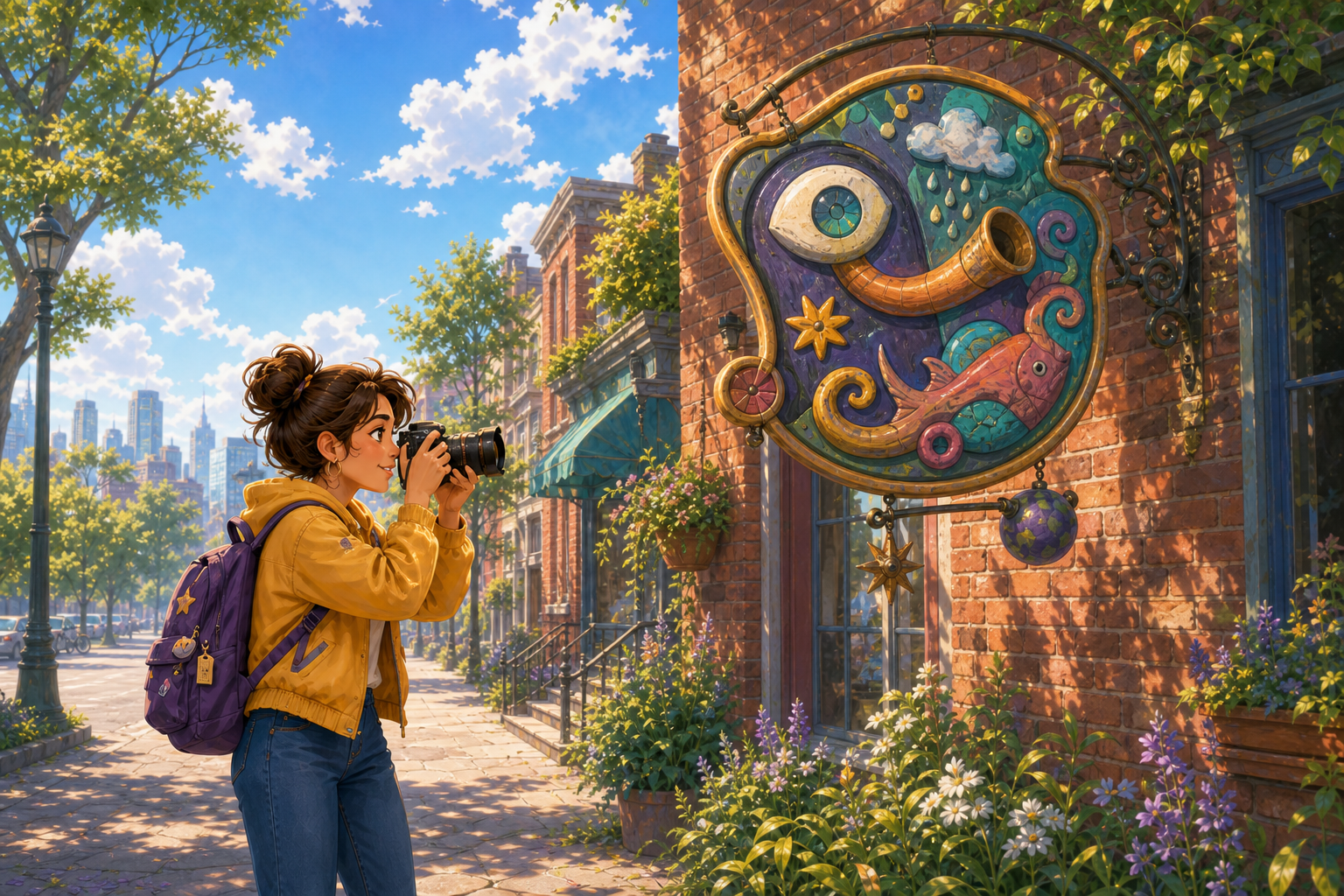
To explore your own city like a tourist, choose one small area and give yourself a specific question to follow. Plan a short route, leave time to notice what is there, and finish with one place or detail you'd show someone else.
You don't need to cover the city's highlights. A few blocks you normally hurry through can be enough. In a smaller town, use the same approach for a main street, public square, or familiar local destination.
Choose a question before choosing a destination
A question makes a familiar place easier to investigate. Try one of these:
- What detail here would make a good postcard?
- Where can you find three different kinds of lettering?
- Which public artwork would you bring a friend to see?
- What can a public sign tell you about this place?
- Where would you pause if you had an extra fifteen minutes?
Pick one. You aren't trying to collect everything interesting in the neighborhood.
Make a route with three different jobs
| Stop | Purpose | Example |
|---|---|---|
| Look | Give one thing your attention | A building exterior, mural, or public sign |
| Pause | Spend time without moving to the next stop | A permitted seating area or public space |
| Browse | Follow a small curiosity | A library shelf, market stall, or shop display |
Choose places close enough for your time and transport options. The route can be walked, rolled, or connected by transit. A single accessible venue can also supply all three kinds of stop.
Check the practical details once
Before leaving, use the venue's own website or local authority's information to check opening hours, entry costs, access, and any booking requirement. Decide your spending limit and how you'll return. Conditions change, so an old recommendation is a starting point rather than confirmation.
Have one alternative nearby or shorten the outing if a place is unavailable. You don't need to turn a closed door into a complicated new itinerary.
Try a forty-five-minute neighborhood visit
- First ten minutes: reach your chosen starting point and look for a detail related to your question.
- Next fifteen minutes: spend time at one stop. Read the sign, look at the artwork, or examine the display instead of immediately moving on.
- Next ten minutes: pause somewhere suitable and write a short note about what you've noticed.
- Final ten minutes: choose one last nearby detail, then begin your planned return.
Treat the times as a suggested framework. Add travel time separately and change the distances or number of stops to suit you.
Keep a tiny field note
Record three things: what you noticed, what you still wonder about, and whether you'd return. A photo of a building detail or a quick sketch can sit alongside the note.
Keep observations separate from guesses. “The plaque says the building opened in 1924” is different from assuming its age from its appearance. If you want to learn more later, save the question and consult an official archive or library resource.
Bring someone who notices different things
For a shared version, take turns choosing what to stop for. One person might notice plants while another notices lettering. Give each person a turn without requiring either to become a tour guide.
At the end, compare your answers to the original question. You may have visited the same three places and chosen completely different details.
Leave with one reason to come back
Your finish might be a favorite detail, an unanswered question, or a place you'd like to revisit. There is no need to declare that you now “know” the neighborhood.
This is one way to turn a familiar setting into a real-life side quest. For more starting points, browse the 21 side quest ideas or explore SideQuest's Local Legend pack in Quest worlds.